For most Sydney service businesses, Google Ads is the right starting point because it produces leads within days, not months. Local SEO takes 3-6 months to produce meaningful results but builds a compounding asset you own. The answer to which comes first depends on your time horizon: if you need customers in the next 30 days, start with ads. If you are thinking 12-24 months ahead, start both simultaneously.
- Google Ads produces leads within 24-48 hours of launch, local SEO takes 3-6 months
- Local SEO builds an owned asset that compounds; Google Ads stops when you stop spending
- Most Sydney service businesses should do both, not choose one
- Map pack ranking is a local SEO outcome that often outperforms paid ads on click rate
- Starting local SEO while running ads is the most capital-efficient approach
- Budget below $1,000/month makes Google Ads hard to justify without strong job values
This is one of the most common questions we hear from Sydney service businesses exploring their marketing options: should I do local SEO or Google Ads?
The honest answer is usually: both, eventually. But if you have to choose one to start with given limited budget and time, the answer depends on your situation.
This guide walks through the decision framework we use when a Sydney operator comes to us wanting to grow their enquiry volume.
What each channel actually does
Before comparing them, it is worth being precise about what local SEO and Google Ads actually produce for a service business.
Google Ads
- Paid traffic from Google Search
- Appears above organic results
- Starts producing leads in 24-48 hours
- Stops the moment you stop spending
- Cost per click ranges $3-$25 for trades
- No compounding value over time
Local SEO
- Organic search rankings + map pack
- Appears below ads, above map results
- Takes 3-6 months to produce results
- Keeps working after you stop investing
- Cost per lead decreases over time
- Compounding value: stronger every month
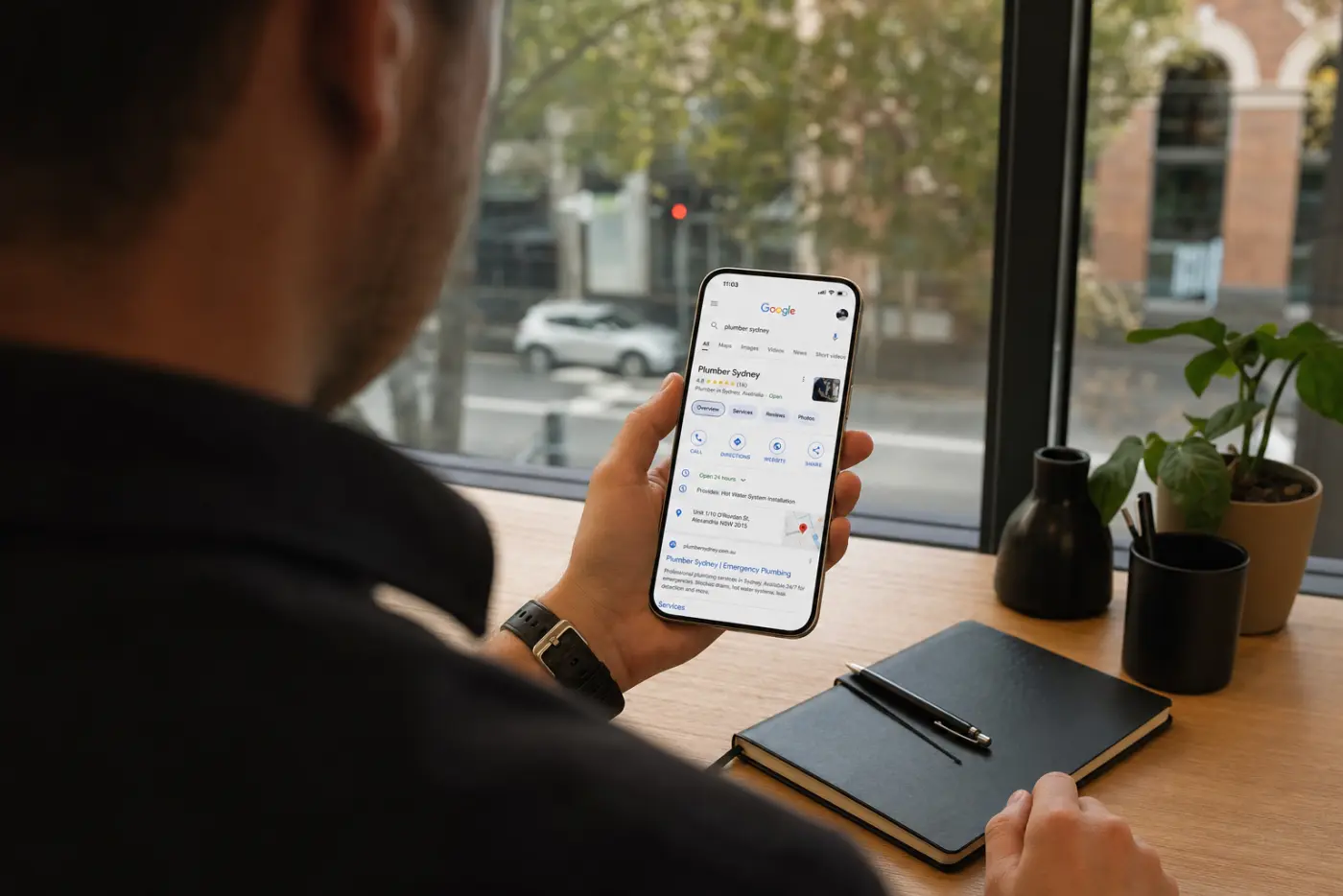
The map pack is a local SEO outcome that deserves special mention. The three business listings in the map pack (the Google map with three business pins) appear above organic results and often above paid ads. Map pack click rates are 2-3 times higher than organic position one.
The decision framework
Four questions help narrow down which channel to prioritise for a specific Sydney service business.
How urgently do you need new customers?
If the calendar is empty and you need jobs in the next 30 days, Google Ads. If you have a 3-month runway, start both simultaneously and let SEO build while Ads are running.
What is your average job value?
If average jobs are over $400, Google Ads cost per lead can be justified. Below $150-$200 per job, the cost-per-acquired-customer math often does not work for competitive Sydney terms.
Do you have an existing online presence?
No website or a very poor one? Google Ads traffic needs a destination that converts. Build the website first, then run ads to it. Local SEO requires a website too.
How long are you planning to operate in this area?
If you are committed to your Sydney area for 3+ years, local SEO is a better long-term investment. If you are uncertain, Google Ads is more flexible.
Why starting both simultaneously makes sense
The best-performing Sydney service businesses we work with run both channels simultaneously. Google Ads fills the short-term calendar while local SEO builds the long-term owned traffic base.
Over 12-18 months, this approach typically produces a shift: organic and map pack traffic grows to the point where Google Ads spend can be reduced or redirected without losing volume. The business is less dependent on paid advertising and owns its own traffic asset.
“The businesses that stop running ads after 18 months of local SEO are not cutting their lead generation. They are spending less to get the same result.”
How Sydney service businesses can run SEO and Google Ads together without waste
When both channels are running at the same time, there are a few practices that prevent the most common form of waste: paying for clicks on branded terms where you would have ranked organically anyway.
- Add your own business name as a negative keyword in Google Ads campaigns, so you do not pay for people already searching for you by name
- Use different phone numbers for each channel so you know which is generating more calls
- Run SEO on suburb terms first before adding them to Google Ads. If you already rank organically in a suburb, that suburb may not need paid ads
- Use Google Ads search term reports to discover suburb and service keyword variations you can build SEO content around
- Set Google Ads spend higher in suburbs where SEO rankings are weakest, then reduce it as organic rankings improve
SEO data improves your Google Ads, and vice versa
Landing page engagement data from Google Ads tells you which messages and service descriptions resonate. Use this to inform the copy on your SEO pages. Google Search Console keyword data tells you which organic terms drive traffic, helping you prioritise which gaps to fill with Google Ads.
When to do local SEO only
There are situations where focusing on local SEO without Google Ads makes sense.
- Budget under $600 per month: Google Ads needs minimum viable spend to generate data
- Service area with very low search volume where ads generate few impressions
- Highly niche service where paid competition is minimal
- Business in early stages building Google Business Profile and website foundation first
What this article is not claiming
There are no made-up retention percentages or enquiry counts in this piece. The framework above is what we have seen play out for service businesses on our own program and what other operators in the space report, but the numbers that matter for your business are the ones for your suburb and your service category, which we can only work out together.
If you want a sample of what an actual enquiry looks like when it lands, ring us and we will send you a sanitised SMS example from a similar trade. That is more useful than any blog statistic.